ArtMotri Journal
Cubism
Picasso, Braque and Gris turn familiar subjects into pictures assembled from planes, patterns and clues.
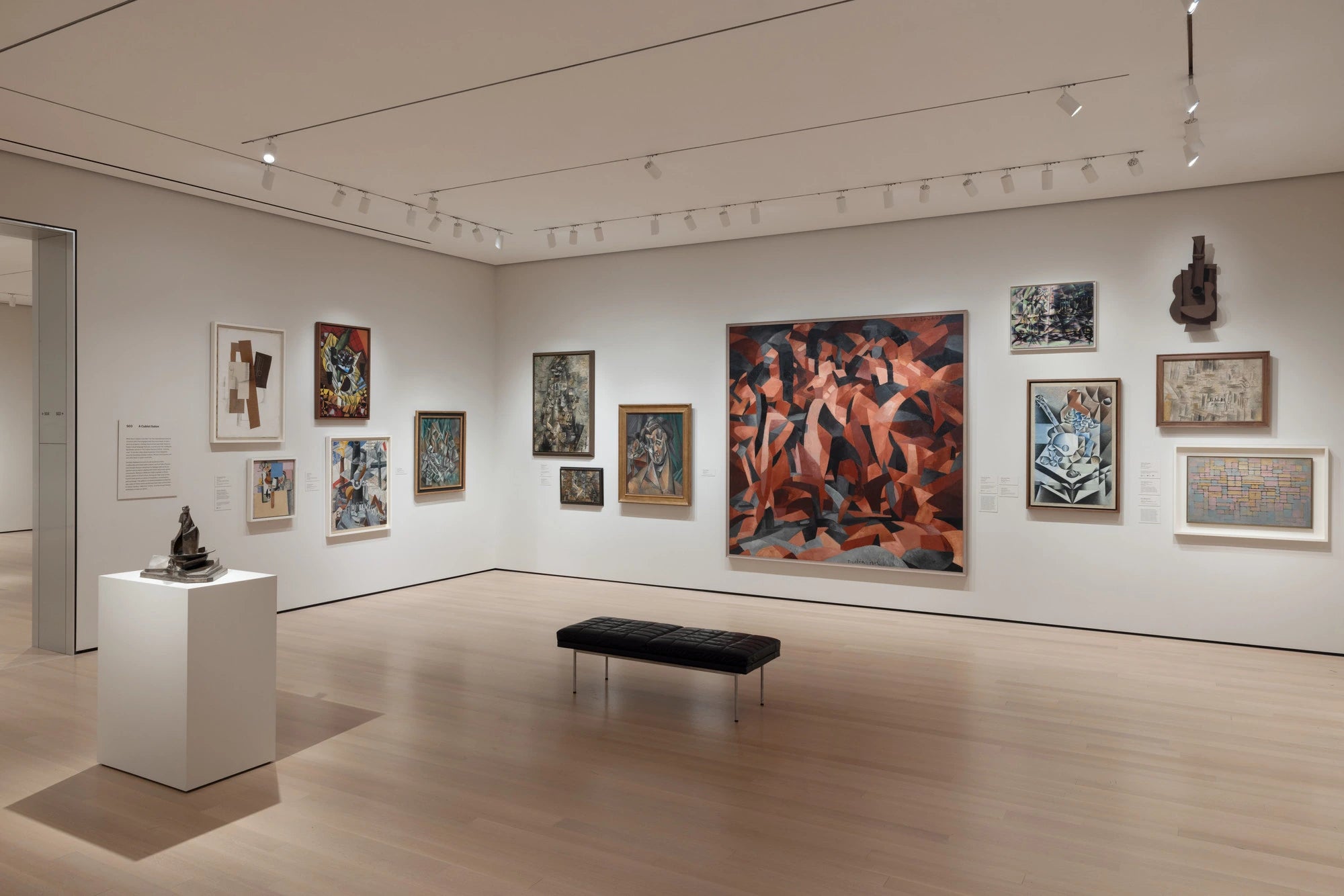
A bottle, a guitar and a newspaper can make a surprisingly demanding picture. Their familiar shapes give us something to recognise, yet their edges, surfaces and viewpoints refuse to settle into a single, continuous room. Cubism asks the eye to move between those possibilities: the object we know, the fragments we can see, and the arrangement of marks in front of us.
Developed through the close exchange between Pablo Picasso and Georges Braque in early twentieth-century Paris, Cubism opened several routes through that problem. Landscape could become a structure of planes; a figure could emerge from a few signs; an actual piece of wallpaper could enter the picture. Juan Gris would give this language a distinctive clarity and playfulness.
Paris, 1907–1914
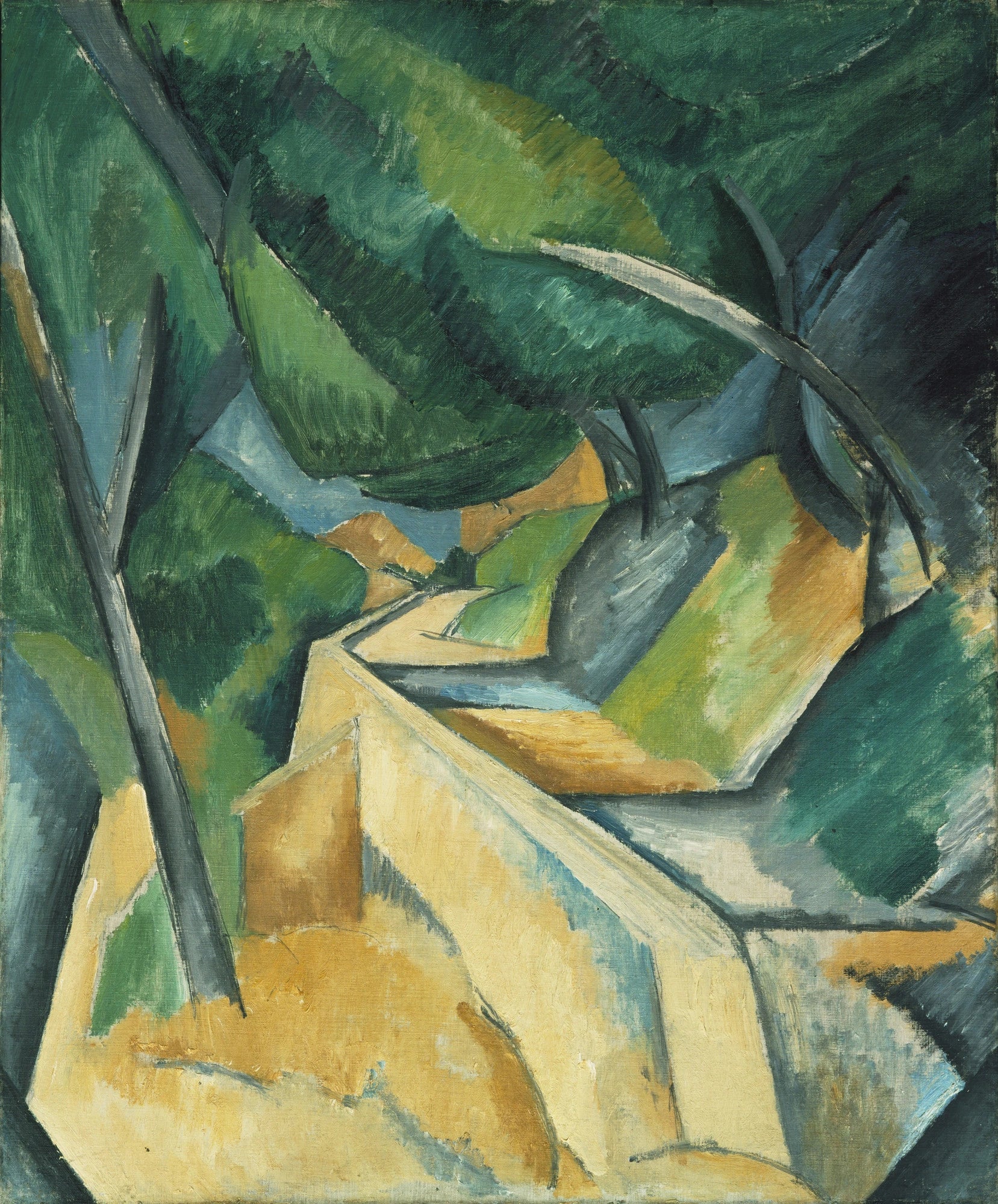
In Georges Braque’s Road near L’Estaque (late summer 1908), the landscape presses towards the surface. Houses, trees and the rising road form a compact arrangement whose angular shapes carry more weight than distant atmosphere.
Paul Cézanne’s paintings, including those shown in his 1907 memorial exhibition in Paris, were important to Braque’s developing approach. Here, the limited range of greens and earth colours allows the shapes to lock together. A building can be read as a solid block and, a moment later, as a patch in the larger pattern.
The road promises a route into the scene, but the crowded forms interrupt an easy passage. That tension offers an early way into Cubism: follow a recognisable object, then notice how its boundaries join the surrounding space. The picture holds the experience of a place alongside the visible work of constructing it.
Pablo Picasso: reading a portrait
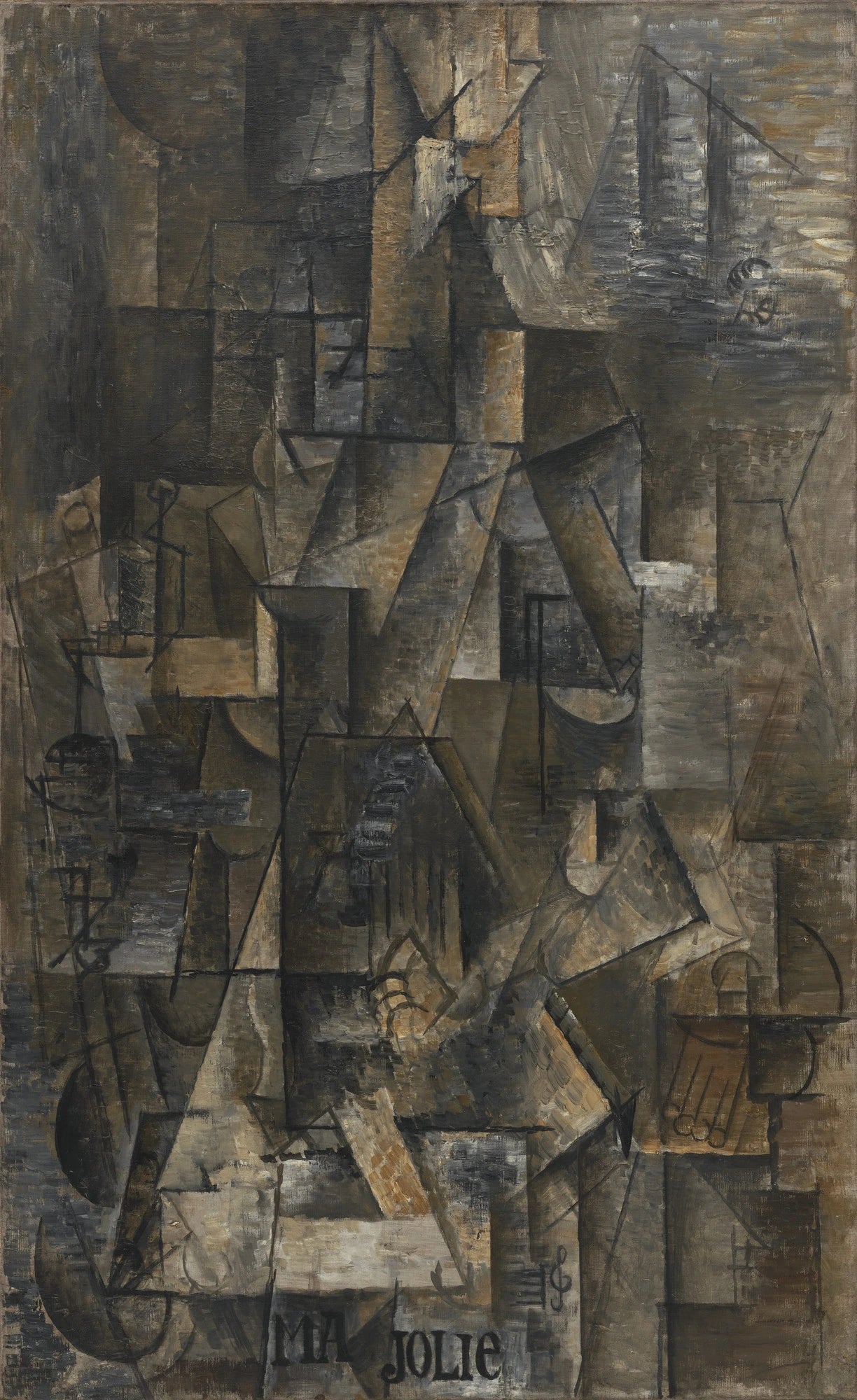
Pablo Picasso’s “Ma Jolie” (winter 1911–12) takes recognition to a quieter threshold. A woman with a guitar is dispersed across small planes, dark accents and slanting lines, with only a handful of firm clues.
The six strings near the lower centre suggest the instrument; an angular form to the right indicates an elbow. Below, the painted words and musical notation are unusually easy to read. MoMA connects the title both with a popular song and with Picasso’s nickname for Marcelle Humbert, the woman associated with the picture.
The different kinds of information operate together. Lettering can be read immediately, while the body takes longer to assemble. This is a useful distinction within Analytic Cubism: a small range of browns and greys can support a remarkably complex exchange between depth, surface and recognition. Allowing a form to remain uncertain is part of looking at the work.
Georges Braque: paper enters the picture
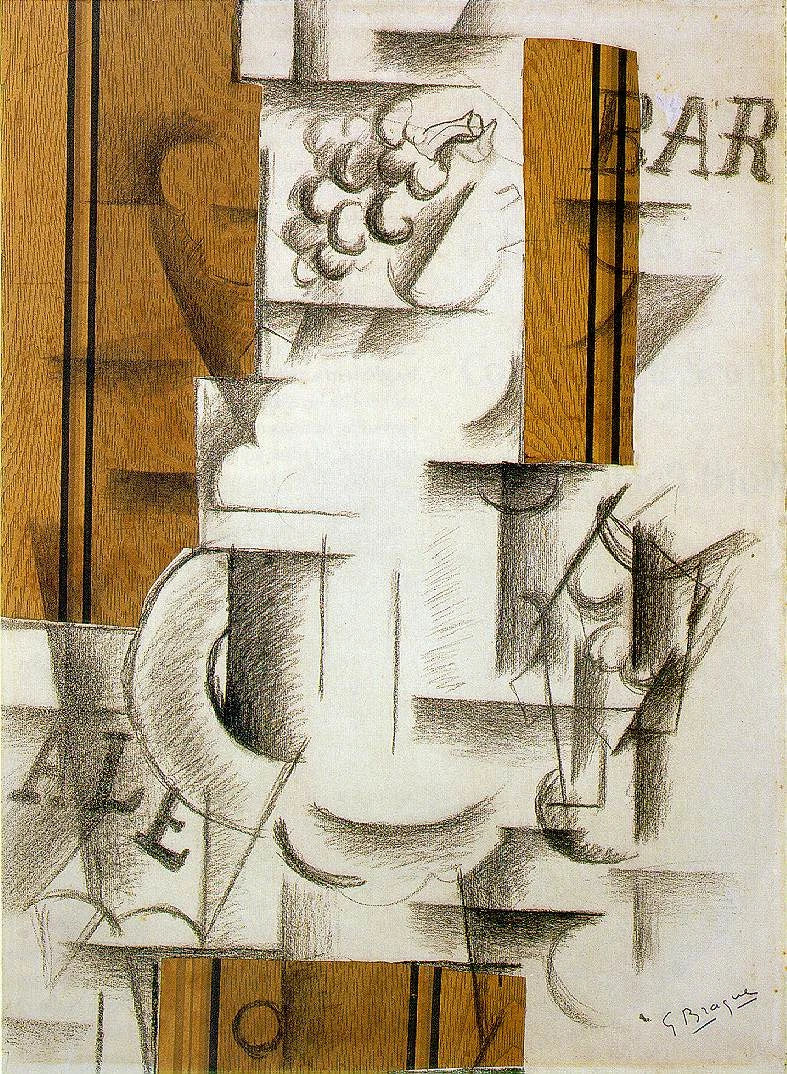
In Fruit Dish and Glass (autumn 1912), Braque placed printed woodgrain wallpaper alongside a drawn still life. The material makes the picture’s physical surface impossible to overlook, even as the drawing suggests objects and space.
The Metropolitan Museum of Art records this as the artist’s first papier collé, made in September 1912. Its three wallpaper pieces introduce an everyday manufactured pattern into the work. They are actual paper, carrying an imitation of another material. Beside them, the charcoal marks offer a different, hand-drawn way of describing what might be on a table.
Analytic and Synthetic Cubism are helpful terms for this change in emphasis. The earlier, densely faceted pictures often ask us to piece a subject together; the later works can begin with larger shapes, patterns and pasted materials. Looking between those approaches reveals how much a picture can communicate through the choice and placement of a surface.
Juan Gris: a still life with another identity
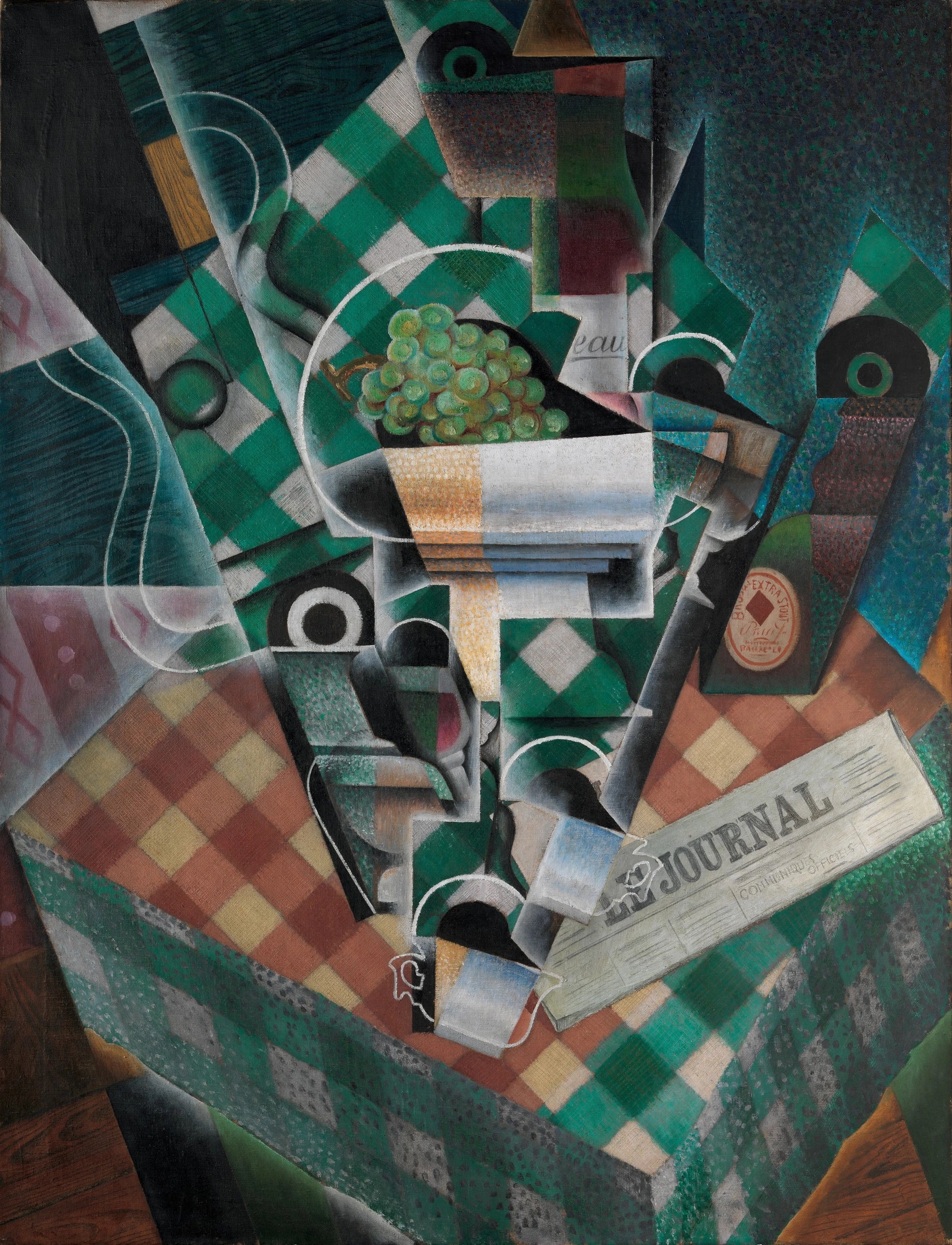
Juan Gris’s Still Life with Checked Tablecloth (spring 1915) gives the table an unusually rich visual rhythm. Checks, curves, lettering and contrasting patches of colour hold together a crowded gathering of familiar things.
Cups, glasses, bottles, a newspaper and a guitar can be followed across the composition. The Metropolitan Museum of Art also identifies a second reading: a bull’s head. A cup becomes its snout, a concentric circle an eye, and the guitar’s curved edge a horn. Recognising one image need not make the other disappear.
The pleasure lies in that reversible attention. A shape changes its role according to what we connect it with. Gris’s strong patterns help the eye travel around the canvas, while the objects provide points of return. The still life becomes an active arrangement in which a few carefully placed cues can sustain more than one coherent image.
A useful way to approach a Cubist picture is to begin with one small certainty: a string, a letter, a rim or a repeated pattern. Follow where it leads, then return to the whole surface. Picasso, Braque and Gris place different demands on that movement of attention. Across these works, ordinary subjects become occasions to reconsider how a picture takes shape, and how we recognise what it holds.